


This year sees the return of Key Stage 1-2 primary progress measures after a two year hiatus so it’s worth reflecting on how they are calculated and how the results are used.
Primary school progress measures have been around in various guises for years. Back in the days of RAISEonline, there were two measures of progress: levels and value-added (VA). Everyone understood the levels measure and tended to focus on it because there were floor standards attached. Value-added? Not so much. It was complicated, weirdly centred on an average score of 100 (it’s now set at 0), and turned blue when things were bad (it now turns red). Schools tended to ignore VA – unless it turned green (hooray!) or blue (booo!).
Going back even further, before the coalition government came into power in 2010 we had CVA – contextual value added – which attempted to compare pupils who were not only similar in terms of prior attainment but also in terms of their characteristics. This seemed fairer but had a habit of lowering expectations for certain groups and exacerbated gaps as a consequence. CVA was ditched in 2011.
2015 was the last year of the ‘Levels of Progress’ (i.e. expected progress) measures and since 2016 we have been left with a value-added model of progress for reading, writing, and maths. These progress scores can be found in the performance tables, Ofsted’s Inspection Data Summary Report (IDSR), and the Analyse School Performance (ASP) system. Now centred on 0 and turning red when significantly below average, we have had a consistent system of progress measures for 10 years.
Well, almost.
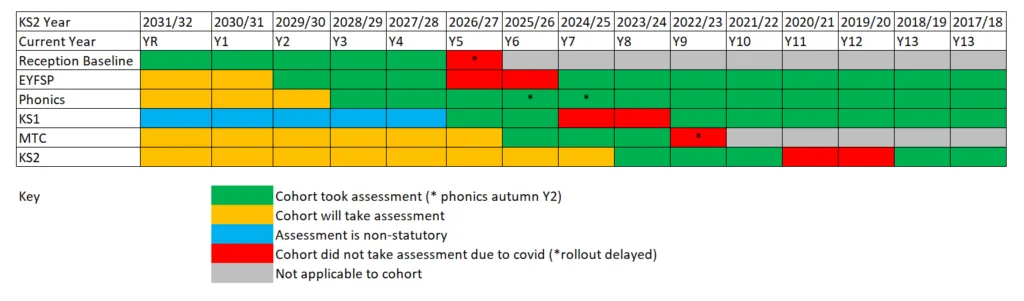
The pandemic resulted in widespread disruption and caused statutory assessment to pause for two years. RBA, EYFSP, KS1, MTC, KS2, GCSE, or A levels – everything stopped. Well, everything except phonics. Nothing stops phonics. But this pause in assessment means we have gaps in the accountability record. There were no published results or progress measures in 2020 and 2021, and the lack of KS1 assessment in those years meant there could be no primary school progress measures in 2024 and 2025 either. This is why the latest progress data in the IDSR is for 2023. It’s also why recent results are not broken down into low, middle, and high prior attainment groups in the IDSR – no KS1 results in year 2 means no prior attainment in year 6.
That all changes this year. The current year 6 and year 5 have key stage 1 results, which means progress can be calculated for these cohorts. After that, in 2028 (the current year 4 cohort), the reception baseline (RBA) kicks in, which is a whole new bowl of spaghetti. It’s also worth knowing that secondary progress measures – also on holiday for two years – will be back next year. The current Y11 do not have KS2 results, the current Y10 and below, do. The diagram below attempts to show which cohorts missed which assessments and when.
And how is progress calculated? The short answer is: the same as before. The Primary School Accountability Technical Guidance gives a highly detailed explanation but, essentially, each pupil’s KS2 score is compared to the national average KS2 score of pupils with the same KS1 prior attainment. For example, in the 2023 – the last year we had progress measures – pupils that met the expected standard in reading, writing, and maths at KS1 (EXS in each subject) scored an average of 105.38 in the reading test at KS2. 105.38 was therefore the reading benchmark for that particular type of pupil in that particular subject in that particular year. Note that the benchmark scores change every year.
And what about the pupils that don’t sit the tests at key stage 2? Pupils that are working below the standard of the assessment – that are working at pre-key stage standards – are not excluded from progress calculations; they are assigned nominal scaled scores, which can be found in the technical guide. Pupils that have no KS1 results or have an invalid KS2 result (i.e. one of those various letter codes) are excluded from these measures. And it’s best not to think too much about the writing progress measure.
Progress is therefore the difference between the national benchmark and the pupil’s actual score. If a pupil exceeds the benchmark, they will have a positive progress score; if they fall short, they will have a negative progress score. This is done for each pupil in the school’s year 6 cohort and the overall progress score is the average of the individual progress scores. If your school has an overall progress score of say +1.95, this means that pupils, on average, exceeded their benchmark scores by approximately 2 scale points.
If you’d like to explore primary progress measures in more detail, you can do so by downloading the VA calculator attached below. Enter KS1 results and note the KS2 benchmark estimates that pupils need to exceed to gain positive progress scores. Then add some KS2 results to see the progress at pupil level on the pupil VA tab, and at school level on the school VA tab.
It’s important to bear in mind that the VA calculator is based on 2023 methodology and that benchmark estimates change every year. The 2023 year 6 cohort had pre-pandemic KS1 start points and post-pandemic KS2 results. The current year 6 have post-pandemic KS1 results and KS2 results that are a likely to show further recovery. This means that the current year 6 cohort is quite different to its 2023 counterpart and I suspect each prior attainment group (PAG) will have higher benchmarks this year. We are also likely to see a reduction in the number of PAGs because there were fewer valid KS1 outcomes for the current year 6 cohort (no p scales!). Fewer KS1 outcomes* means less differentiation.
Hope you find the tool useful.
*Valid KS1 outcomes for 2026 Y6 cohort: EM, PK1, PK2, PK3, PK4, WTS, EXS, GDS
Insight users
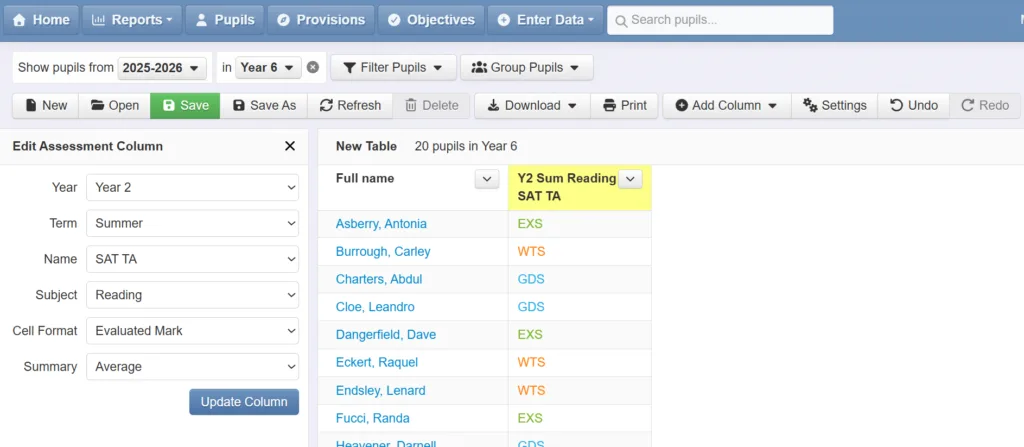
If your school uses Insight, you can populate this tool by exporting a table of your current year 6’s KS1 results, which you can then paste into the spreadsheet. Go to Reports > Tables, select year 6 in the year filter at the top of the screen, and add assessments columns with selections shown in screenshot below. Repeat for reading, writing and maths. Click download, export to excel and copy and paste the data into the column for pupil names and KS1 results. Note: use Paste Special > Values (Ctrl + Alt + V) rather than standard paste to preserve formatting. Also, beware hidden columns – pasting into these will overwrite the formulae.


Leave a Reply