

This is the second in a series of posts explaining the key statutory assessments in England. Here we look at the Phonics Screening Check.
In summary:
The Department for Education (DfE) introduced the Phonics Screening Check (PSC) in June 2012. Schools with Year 1 children (those who will be six years old between 1 September and 31 August) must administer the PSC in June each year. Those children who do not achieve the expected standard must be reassessed in Year 2 at the same time Year 1 are assessed.
The PSC is administered by an adult who works one-on-one with children being assessed.
School level results of the PSC are not published publicly. Summary PSC results are published at national, regional and local authority level, usually in the October following the June assessment. Parents and carers receive a report with their children’s results.
What is the purpose of the PSC?
The 2006 Rose Review concluded that ‘the systematic approach, which is generally understood as ‘synthetic’ phonics, offers the vast majority of young children the best and most direct route to becoming skilled readers and writers’ (Independent review of the teaching of early reading, Rose, p5).
The Department for Education, which introduced the PSC to ensure that schools teach systematic synthetic phonics, issues guidance which summarises the purpose of the PSC as follows:
‘The purpose of the phonics screening check is to confirm that all children have learned phonic decoding to an age appropriate standard’. Parents are advised that ‘The check is designed to give teachers information on how (children are) progressing in phonics. It will help to identify whether (children need) additional support at this stage, so that they do not fall behind in this vital early reading skill’.
How does the PSC assess children’s phonic decoding?
The PSC content domain contains two sections, the first of which is a prescribed set of grapheme-phoneme correspondences which can be used to construct single-syllable words. This section is described as ‘easier’ for children. The second section prescribes a further set of grapheme-phoneme correspondences which are more complex than section 1. The assessment consists of 20 real words and 20 pseudo-words which children must decode. Pseudo-ords (phonologically plausible but not ‘real words’) are included to reduce bias which might be introduced if all words could be pronounced from memory alone (via familiarity/shape recognition, for example).
The PSC assessment has two sections. The first consists of easier words to ensure the assessment is accessible to all pupils. This has 12 pseudo-words and 8 real words. The second section consists of more complex grapheme-phoneme correspondences. It has 8 pseudo-words and 12 real words.
How does the PSC work in practice?
The PSC has an assessment window which is usually Monday to Friday in the second week of June. Children work one-on-one with an adult. The adult administering the check has a booklet with four words written on each page, which they show to the child.
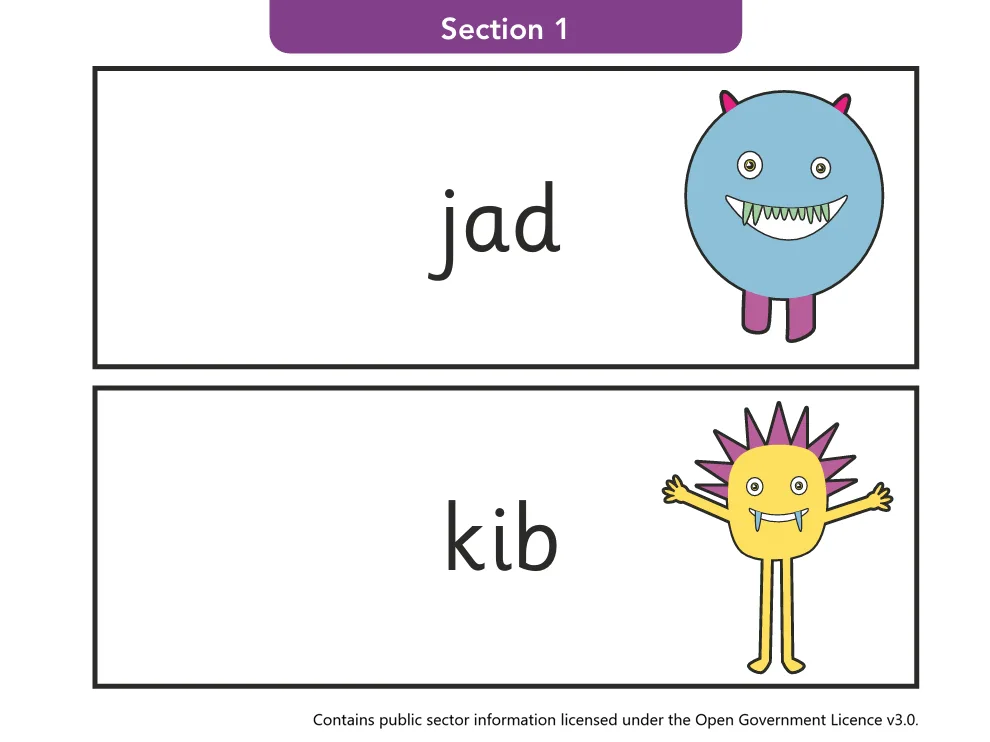
The pages with pseudo-words (referred to in the rubric as ‘the names of imaginary creatures’) have pictures of creatures next to each pseudo-word. The adult tells the child whether the page they are looking at has real words they ‘may have seen before’ or has ‘names for types of imaginary creatures’.
The child decodes the word and the adult records whether the answer is correct or incorrect. The adult can also record any comments if necessary.
The maximum score on the PSC is 40. From 2012 to 2025, the expected standard (the ‘pass mark’) was 32. In 2026 it was 31. The percentage of pupils reaching the expected standard over time is pictured below.
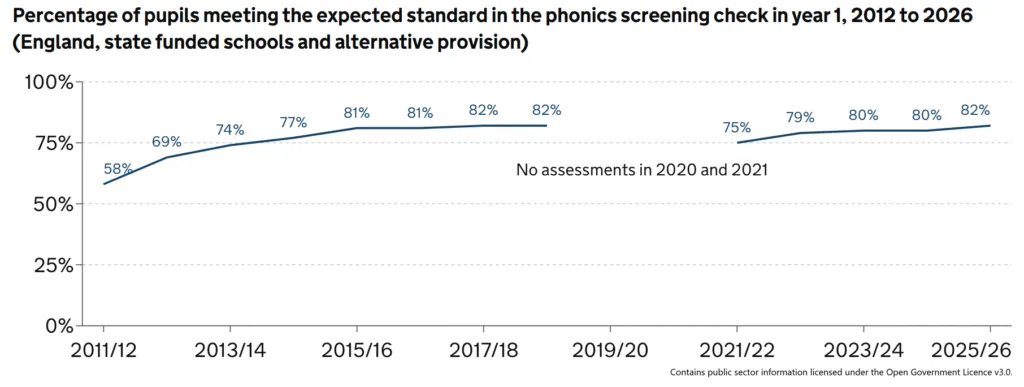
Where children do not reach the expected standard in Year 1, they must be reassessed in Year 2.
What do schools get from the process?
Schools get information about children’s phonics knowledge and decoding skills, along with early identification of children who require additional support in phonics.
The administration (particularly the ability to record comments on errors) can support schools in their future planning.
As schools administer the assessment and must report the scores to their Local Authorities, they have their own PSC scores which can be imported into data tracking systems such as Insight. Insight provides Estimated National Statistics, summarising at national level the data which has been entered into the system following the PSC check each June before the official publication of results in October.


Leave a Reply